
This guide explains how to buy brand new stock kitchenware by the container from China. It covers what brand-new stock kitchenware means, the product families available, how mixed kitchenware is packed, what a 20FT or 40FT loading reference looks like, and the variables buyers should confirm before ordering. It is written for importers, wholesalers, distributors, discount retailers, chain retailers, and other large B2B buyers who purchase kitchenware in container quantities.
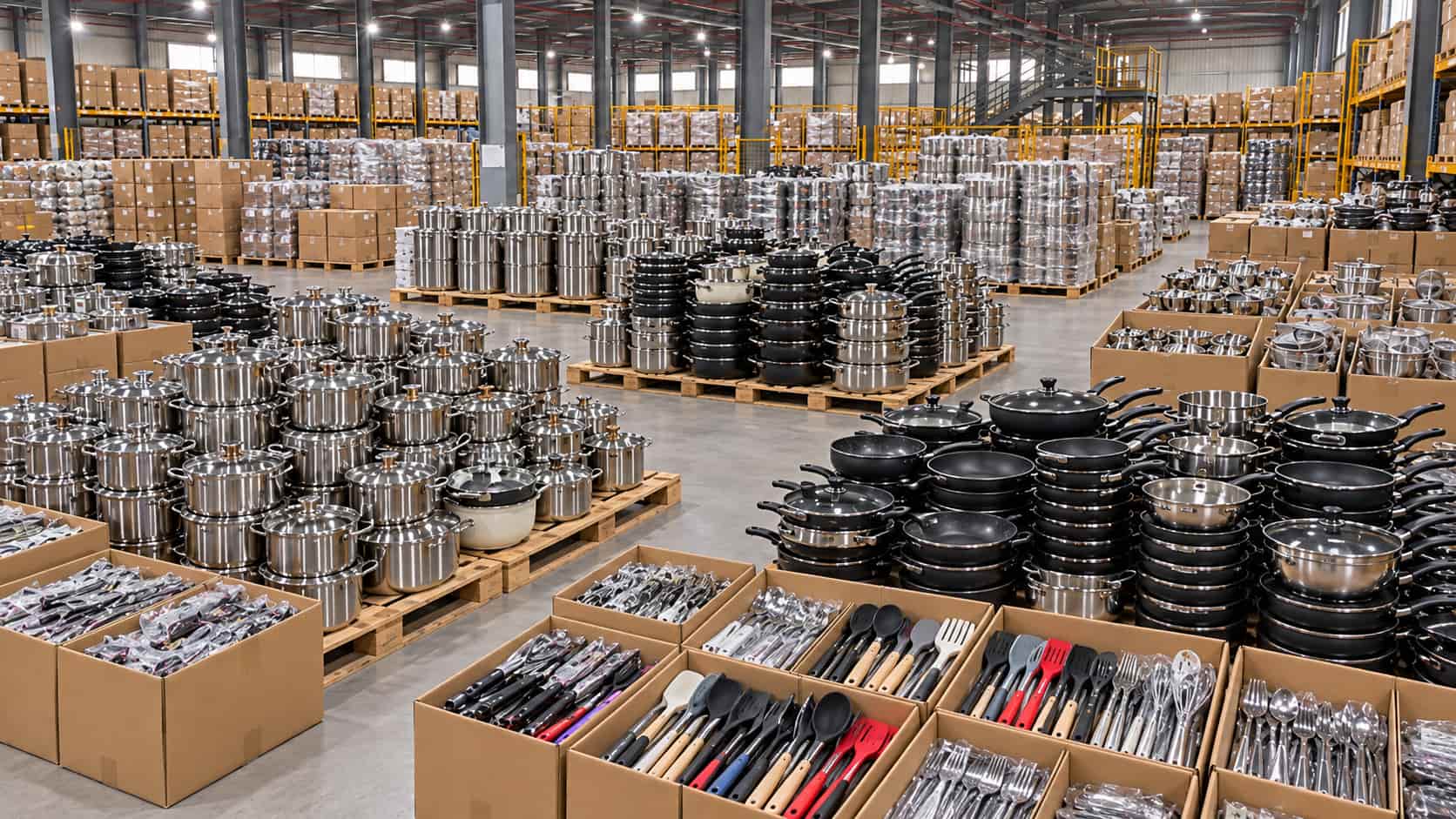
*Illustration: mixed brand-new stock kitchenware ready for container wholesale.*
Stock kitchenware is brand-new cookware, cutlery, knives, and kitchen tools supplied from available inventory rather than made to order for a single buyer. This guide covers 100% brand-new stock kitchenware with no signs of use.
The key difference from a normal production order is the starting point. A production order starts with a specification and builds the product; a stock purchase starts with what is already in the warehouse. That means the buyer works with current availability, so product mix and packing can vary from one shipment to the next.
Because stock lots are built from current inventory, the families and quantities available can change. Confirm the current stock and product mix with the supplier before you plan a container.
Because condition and completeness are the biggest variables in a stock lot, put what you are buying in writing. A short clause stating that the goods are 100% brand new with no signs of use gives both sides a reference point if the shipment does not match the description.
Stock kitchenware is typically grouped into five product families. Starting a purchase with a clear family helps you match the stock to your market instead of buying a container of mixed items you cannot sell.
| Product Family | What It Represents |
|---|---|
| Pure Cookware | Pots, pans, and stock pots |
| Cutlery | Forks, knives, and spoons |
| Knives | Kitchen knives |
| Mixed Stainless-Steel Kitchenware | A pre-mixed assortment of cookware, cutlery, and tools in one shipment |
| Kitchen Utensils | Kitchen tools such as spoons, spatulas, and similar items |
Not every family will be available at the same time. Ask the supplier which families are in the current stock, and confirm the quantities before you plan a container.
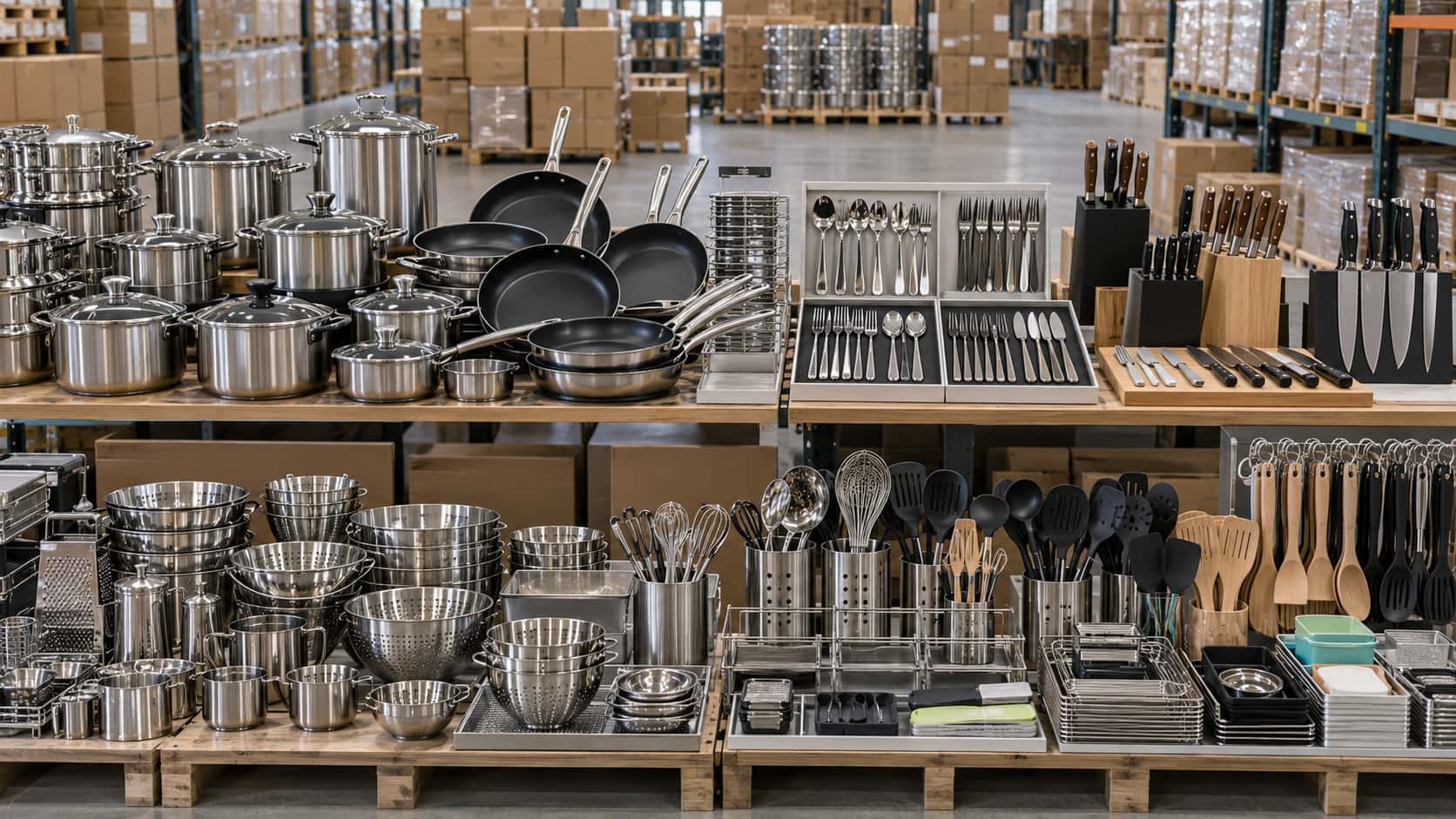
*Illustration: the main product families in brand-new stock kitchenware.*
A mixed stainless-steel kitchenware container is a single shipment that combines several kitchenware categories in one load. It lets an importer spread product risk across categories instead of betting the whole container on one item.
The packing reference below is for mixed stainless-steel kitchenware. It shows the carton weight, carton size, and the product mix structure.
| Packing Attribute | Value |
|---|---|
| Carton weight | 45 kg |
| Carton size | 60 × 45 × 50 cm |
| Carton volume | ≈0.135 CBM |
| Mix structure | approx. 1/4 large items (12 kg) + 2/4 medium items (23 kg) + 1/4 small items (10 kg) |
The mix structure matters because it balances heavy, low-volume items against lighter, higher-volume pieces. A load made up mostly of large stock pots will be heavy but lower in piece count, while a load made up mostly of cutlery will be light and may not use the carton volume efficiently. A balanced mix helps you use the container space and the allowed weight.
That layout is a reference for mixed stainless-steel kitchenware, not a guarantee that every container will have the exact same assortment. Confirm the current product mix with the supplier for your shipment.
Use the reference to plan by weight, not just by carton count. For mixed kitchenware, a 20FT container is around 230 cartons and 10,350 kg, and a 40FT is around 450 cartons and 20,250 kg. A container can be limited by weight or by volume; confirm which limit applies to your own mix, then confirm the carton count you should plan.
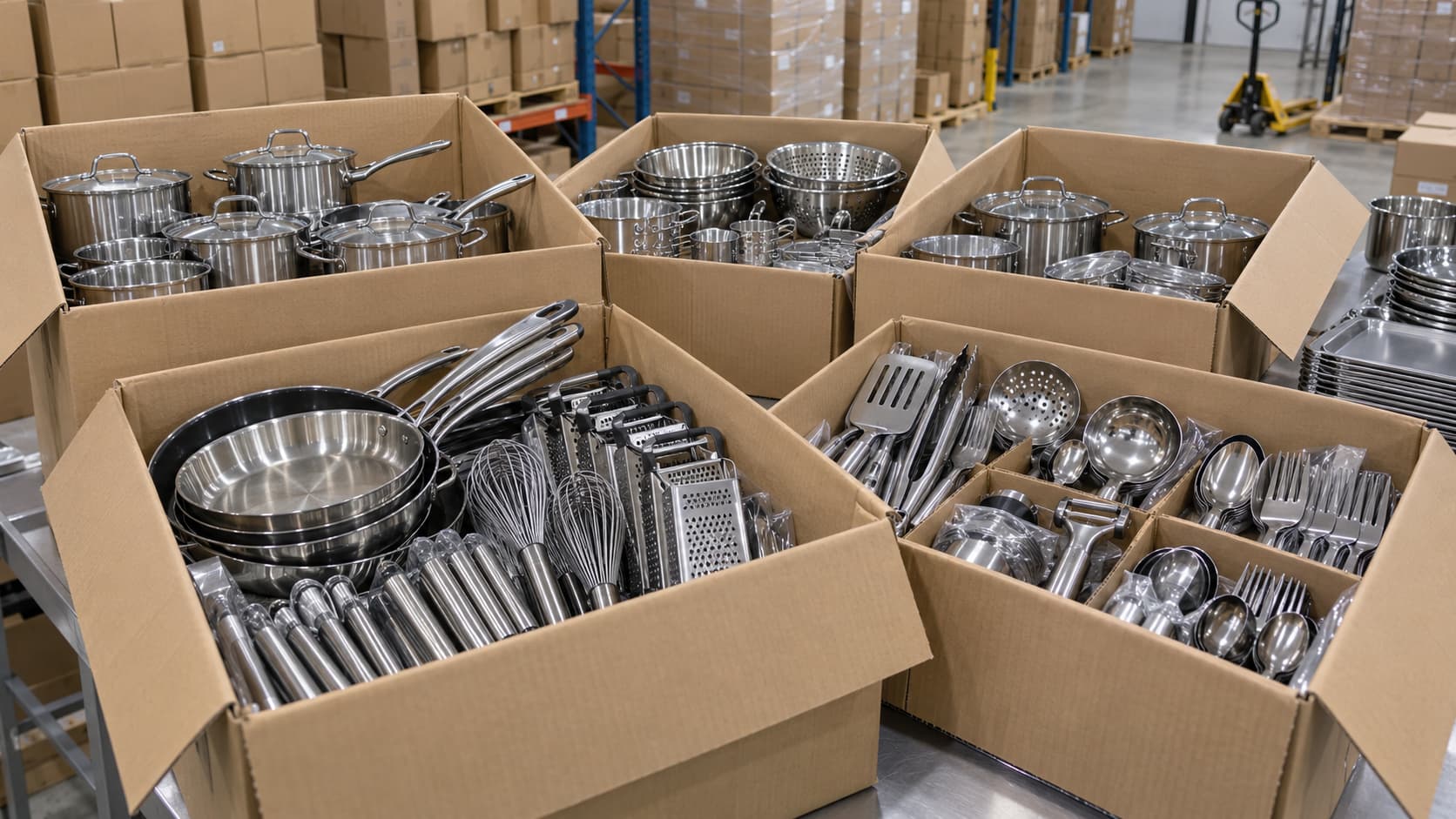
*Illustration: mixed kitchenware packed in export cartons.*
For mixed kitchenware, the current loading reference is approximately 230 cartons with a total weight of about 10,350 kg for a 20FT container, and approximately 450 cartons with a total weight of about 20,250 kg for a 40FT container.
| Container | Approx. Cartons | Approx. Total Weight |
|---|---|---|
| 20FT | 230 cartons | 10,350 kg |
| 40FT | 450 cartons | 20,250 kg |
This is a loading reference for mixed kitchenware, not a figure that applies to every individual kitchenware family. Different families and different mixes can load differently.
Use these numbers to plan how many containers you need, then confirm the actual reference with the supplier for your specific product mix. A container can be limited by weight or by volume depending on what is inside.

*Illustration: cartons staged for container loading (not an exact load count).*
The variables below decide what you can resell, how well the container is filled, and how easy the goods are to sell in your market. Confirm each one before you commit.
| Variable | What to Confirm | Why It Matters |
|---|---|---|
| Product category / family | Which families are in the current stock | Determines whether the stock matches your market |
| Material & coating | Whether the items are stainless steel, coated, or silicone | Changes the selling point and target buyer |
| Product size | Item dimensions and how they vary across the carton | Size consistency affects retail value and resale |
| Product mix | Ratio of large, medium, and small items | Affects container fill and piece count |
| Packing | Carton weight, size, and CBM | Affects loading, freight, and handling |
| Container mix | Whether you plan a 20FT or 40FT load | Changes total cartons and total weight |
Do not rely on a supplier description alone. Ask for the carton weight, carton size, and product mix in writing so you can plan the container and estimate the piece count.
Write these fields into a short sourcing brief before you contact suppliers. That lets you compare offers on the same points, and it makes it easier to see which supplier can confirm the packing and the product mix for your target container.
Stock lots are sold as-is from current inventory, so the buyer should verify condition and completeness before confirming the order. The checkpoints below are what a buyer should confirm. They are procurement guidance, not a claim that any specific supplier performs a particular inspection.
| Checkpoint | What to Check |
|---|---|
| Accessories / set completeness | Whether every set has its full parts |
| Rust / surface | Whether the surface is free of visible rust |
| Handles | Whether handles are intact and secure |
| Lids | Whether lids are present and complete |
| Coating condition | Whether the non-stick coating is in usable condition |
| Size consistency | Whether sizes are consistent within the carton and container |
| Packing / carton condition | Whether cartons are intact and fit for shipping |
Because these are the variables that affect whether the goods are sellable, it is worth confirming them with the supplier rather than assuming them. For a stock lot, the safest approach is to define the condition and completeness you expect in writing before you pay.
In a stock lot, the best check is the representative carton, not the whole container description. Ask the supplier to confirm a representative sample of the carton contents, so you can see the actual mix of large, medium, and small items and confirm the packing before you commit.
Use the steps below as a buyer due-diligence sequence before you confirm a container.
This is buyer due-diligence guidance, not a supplier sales process or an inspection guarantee. It helps you cover the points that change the outcome of a stock purchase.
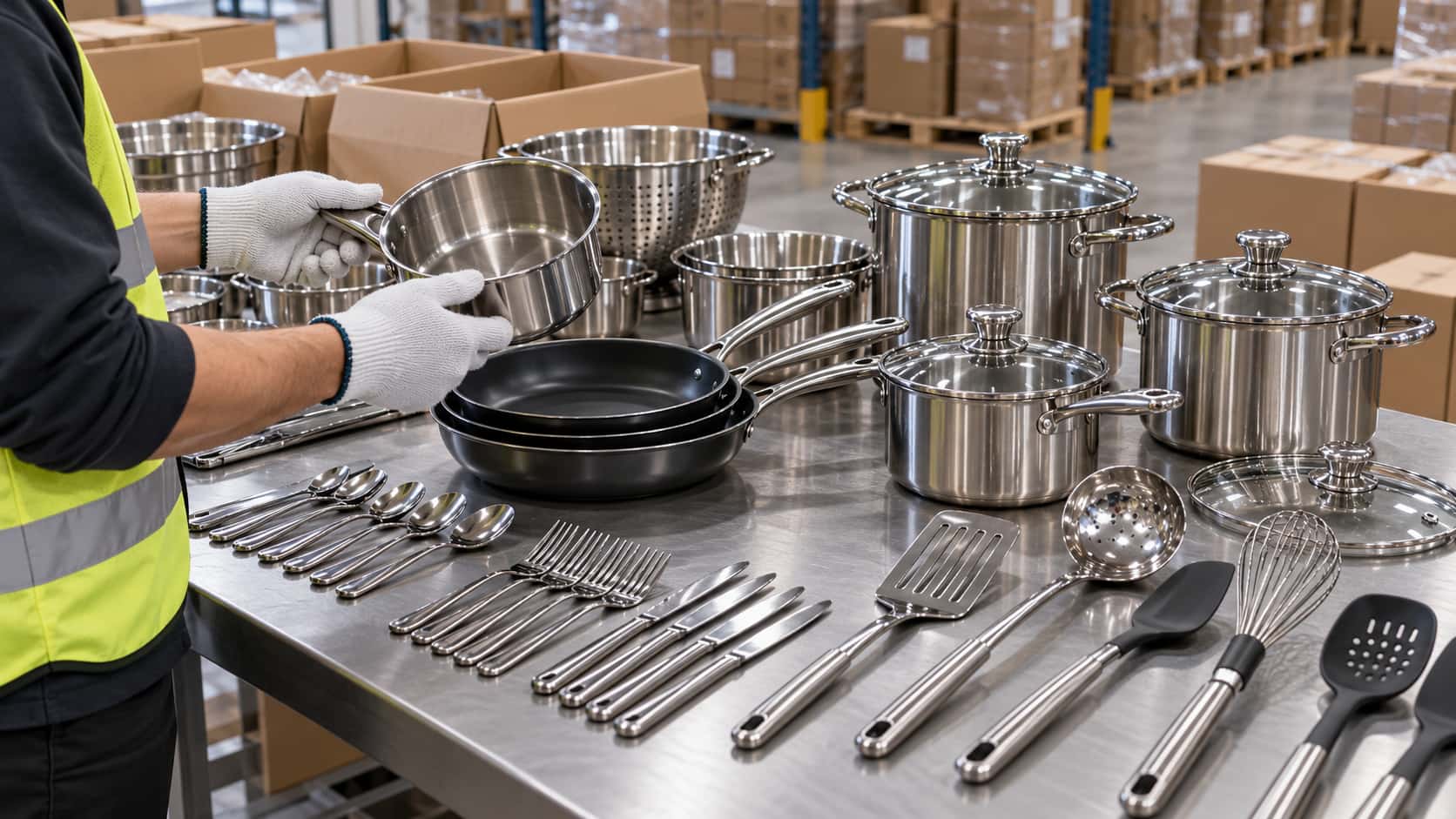
*Illustration: buyer review of stock kitchenware condition (not a documented QC record).*
| Final Buyer Check | Confirmed / Reviewed? |
|---|---|
| The required kitchenware product family is clearly identified | ☐ |
| The intended mixed-product composition has been reviewed | ☐ |
| Product-condition requirement is confirmed as 100% brand new / no signs of use | ☐ |
| Relevant product specifications available for the selected stock have been reviewed | ☐ |
| Carton packing specification has been confirmed for the selected configuration | ☐ |
| The planned container type is confirmed | ☐ |
| The correct mixed-kitchenware loading reference has been reviewed (20FT ≈230 cartons / ≈10,350 kg, or 40FT ≈450 cartons / ≈20,250 kg) | ☐ |
| Product areas relevant to resale quality (handles, lids, surfaces, coatings where applicable) have been checked | ☐ |
| The final product mix is appropriate for the buyer’s intended sales channel / market | ☐ |
| The final category, packing, and container configuration have been reconfirmed before order confirmation | ☐ |
What is stock kitchenware?
Stock kitchenware is brand-new cookware, cutlery, knives, and kitchen tools supplied from available inventory rather than produced to order.
Is the kitchenware brand new?
Yes. This article covers 100% brand-new stock kitchenware with no signs of use.
What product categories are available?
Stock kitchenware is grouped into five families: pure cookware, cutlery, knives, mixed stainless-steel kitchenware, and kitchen utensils.
What can mixed kitchenware include?
A mixed kitchenware shipment combines several categories in one load, with a balanced mix of large, medium, and small items.
How much fits in a 20FT container?
For mixed kitchenware, the loading reference is approximately 230 cartons with a total weight of about 10,350 kg.
How much fits in a 40FT container?
For mixed kitchenware, the loading reference is approximately 450 cartons with a total weight of about 20,250 kg.
What should buyers confirm before ordering?
Confirm the product category, product mix, specifications, packing, container reference, and the condition clause in writing.
If you are planning a mixed kitchenware container, confirm the current stock, product mix, and packing before you commit. Tell us the kitchenware category you are looking for, the container type you are planning, and your target market so we can confirm the current loading reference for your mix.
—


